Apr 08, 2023
The pulley lagging rubber sheet is a layer of material that is attached to the pulley shell of a conveyor pulley. The primary purpose of the pulley lagging rubber sheet is to shield the shell from dents and cracks and to increase friction with the conveyor belt. There are several different types of pulley lagging available in the market including ceramic, plain rubber, and grooved rubber. Every single kind of pulley lagging has unique requirements and variants that may be applied in a variety of situations. Customers choose Oliver's pulley lagging sheets because it offers superior resistance and traction against wear and strain. The pulley shell is protected by this soft substance, which increases friction with the conveyor belts.
With the assistance of pulley lagging, the damage that the conveyor belt and shell sustain may be successfully eliminated. To get the desired outcome, the thickness and hardness of pulley lagging sheets may be customized.
Pulley lagging is a covering applied to the pulley's shell to provide a textured surface for a better grip with the belt. It plays a crucial role in preventing belt slippage, which can cause reduced conveyor belt efficiency, increased maintenance costs, and safety hazards. Pulley lagging offers several benefits, such as:
In short, pulley lagging is an essential component of conveyor belt systems that can help optimize performance and safety.
There are several types of pulley lagging materials available on the market, each with its unique characteristics and applications. Here are some of the common types:
Made from natural or synthetic rubber, it provides excellent grip and wear resistance, making it ideal for heavy-duty applications. It also offers some degree of cushioning to reduce the impact of the material on the belt.
Made from ceramic tiles or cylinders, it provides superior wear resistance, even in highly abrasive environments. It is often used in mining and quarrying applications.
It features diamond-shaped grooves that offer excellent grip and are ideal for wet or slippery conditions.
It consists of strips of rubber that are applied to the pulley shell, providing a cost-effective solution for light-duty applications.
Choosing the right type of pulley lagging depends on several factors, such as the type of material being conveyed, the conveyor speed, and the operating conditions.
Using high-quality pulley lagging can offer several benefits, including:
Investing in high-quality pulley lagging can result in long-term cost savings and improved performance for your conveyor system.
Proper installation of pulley lagging is critical to ensure maximum performance and lifespan. Here are the general steps involved in the installation process:
It's essential to follow the manufacturer's guidelines and recommendations for specific installation procedures and adhesive types. Hiring a professional installer can ensure proper installation and optimal performance.
Choosing the right pulley lagging will increase friction, stopping the belt from slipping. Pulley lagging helps to increase the life of your belt, especially for applications that require high rotation speeds. Quality pulley lagging is an investment to your business, as it reduces the wear on equipment and maximizes the value of your application.
While choosing the material for pulley lagging, one must take into account its resistance to temperature, light (UV), oils, fats, acids, alcohols, and water, as well as its compatibility with food items. With over 35 years of expertise, Oliver Rubber Industries LLP is able to advise and suggest to our clients the selection of a lagged pulley material that is compatible with the conveyed material and resistant to the circumstances of the desired environment.
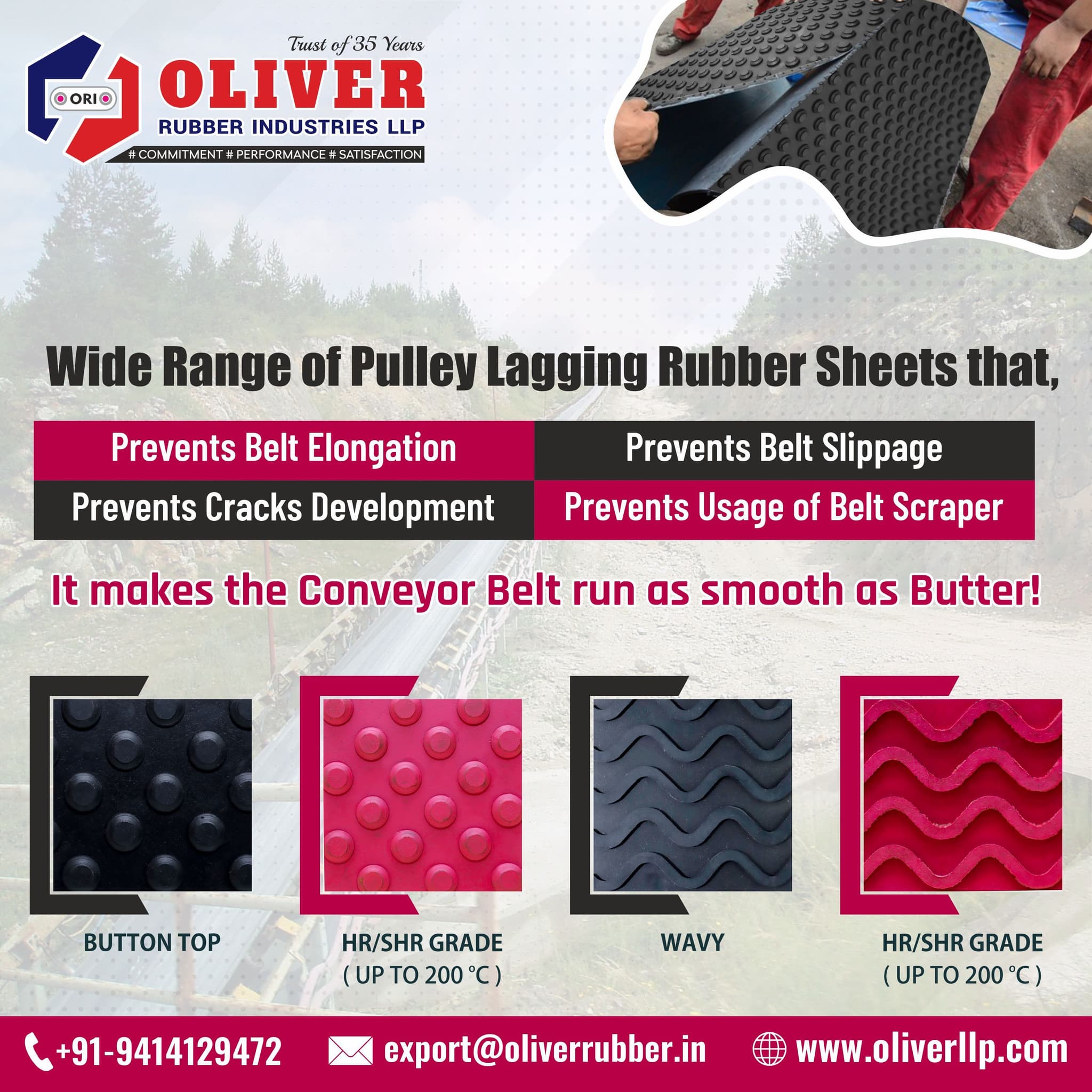
Pulley lagging also depends a lot on the material of the conveyor belt. If the belt is utilized for carrying high-temperature goods, heat-resistant conveyor belts must be in use and for that purpose wavy and button-type pulley lagging sheets (pink in color) are used, and they are the best rubber sheets for such material.
Pulley lagging is ideally done by jointing lagging sheets to the pulley with the help of either a cold vulcanizing joint solution (OM-2000) or hot vulcanizing methods (preferred for more bonding strength). If done properly, cold vulcanizing can provide satisfactory results for light to medium pulley applications. However, it does not offer 100% rubber tear adhesion which means service life is somewhat reduced. Cold vulcanizing is simpler to accomplish than hot vulcanizing, which lowers costs and provides faster lead times. A significant advantage of cold bonding is the ability to make urgent lagging repairs without removing the pulley from the conveyor. Although, cold vulcanizing has the drawback that a variety of failure mechanisms may manifest themselves,. The pulley's performance may be greatly impacted by the corrosion of the pulley shell as a result of this. The rubber lagging may conceivably separate from the pulley shell when the pulley shell corrodes. To eliminate the rust, the pulley shell will need to be machined, which will make it thinner. However, OM-2000 works extremely well in jointing lagging sheets to the pulley and can be as useful as a hot vulcanizing process.